
Warehouse Cooling: MrCool Fans and Mini Splits
Warehouses are expensive to cool. Learn the most cost-effective strategies using MrCool fans for general circulation and mini splits for occupied zones.
Admin User
Author
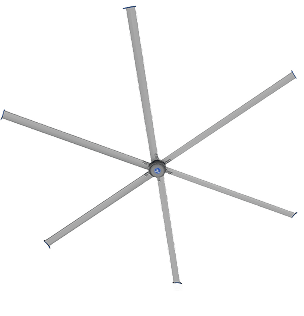
Warehouse Cooling: MrCool Fans and Mini Splits
Cooling a warehouse is one of the most expensive HVAC challenges in commercial settings. High ceilings, large footprints, constantly opening dock doors, and minimal insulation make traditional air conditioning impractical and prohibitively expensive for most warehouse operations.
The smart approach combines high-volume fans for general comfort with targeted mini splits for occupied zones — giving you effective cooling where it matters at a fraction of the cost.
Why Traditional AC Doesn't Work for Warehouses
The Math Problem
A typical 10,000 sq ft warehouse with 20-foot ceilings has 200,000 cubic feet of air volume. Air conditioning that space would require:
- 25-40 tons of cooling capacity (300,000-480,000 BTU/hr)
- Equipment cost: $50,000-$150,000
- Monthly energy cost: $3,000-$8,000
- Duct installation: $20,000-$50,000 for a space this large
For most warehouse operations, the ROI simply isn't there. You'd spend more on cooling than on the goods being stored.
The Real Need
In practice, most warehouses don't need the entire space maintained at 72°F. What they actually need is:
- Employee comfort in occupied work areas (packing stations, offices, break rooms)
- General air circulation throughout the warehouse to prevent stagnant hot spots
- Temperature-sensitive zones kept within safe ranges (certain inventory, electronics, food)
- Dock areas managed during loading/unloading
The Two-Tier Strategy
Tier 1: High-Volume Fans for General Circulation
Large fans provide the most cost-effective comfort improvement for warehouse spaces. Moving air at 2-6 mph creates a perceived cooling effect of 7-11°F through evaporative cooling from skin — making a 90°F warehouse feel like 79-83°F.
Benefits of fan-based cooling:
- Energy cost: A large ceiling fan uses 100-300 watts — roughly $5-$15/month to run 24/7
- Coverage: A single large fan circulates air in a 2,000-5,000 sq ft area
- No ductwork: Fans mount directly to the ceiling structure
- Destratification: In winter, fans push warm air that collects at the ceiling back down to floor level, reducing heating costs by 20-30%
- Installation: Simple electrical connection to existing circuits
MrCool fans are designed for both residential and light commercial applications, providing powerful circulation in a quiet, energy-efficient package.
Tier 2: Mini Splits for Occupied Zones
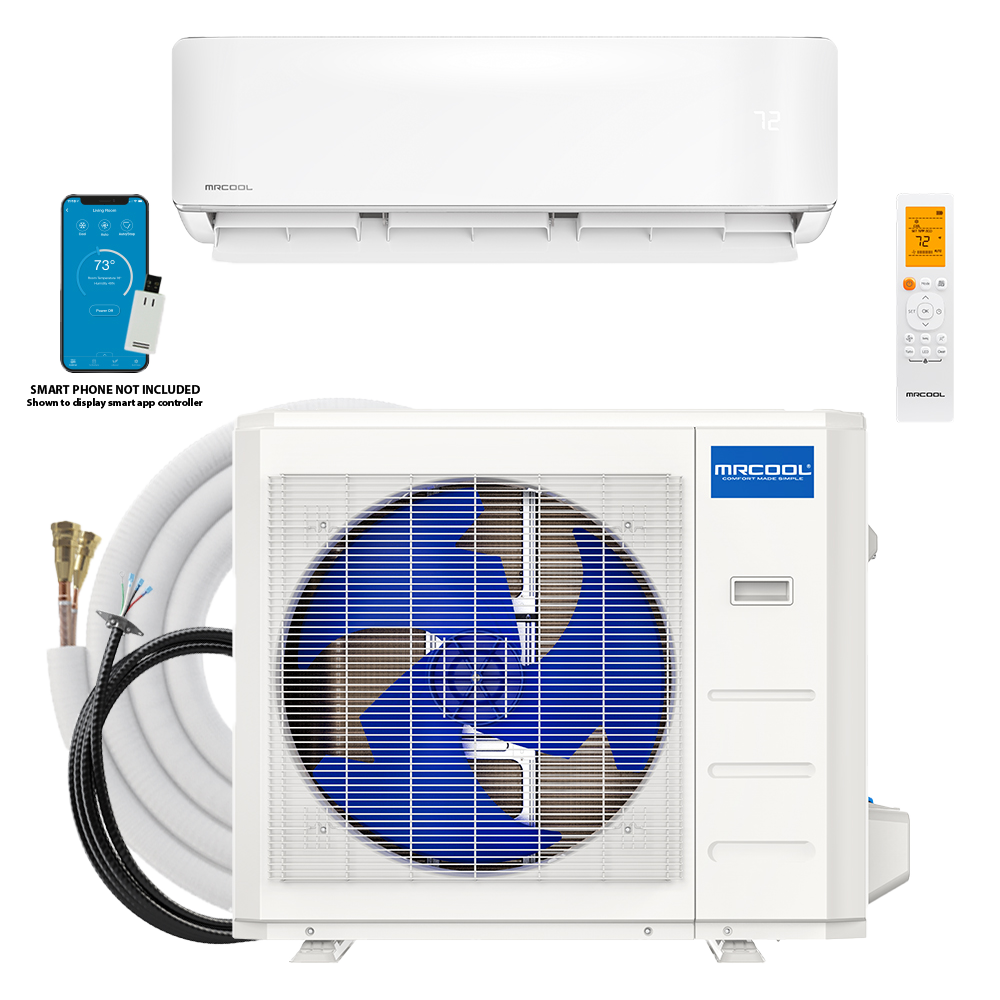
While fans make the general warehouse more bearable, specific areas need actual cooling:
Packing/Shipping Stations Workers spending 8 hours at a packing station need real cooling. A 12K BTU or 18K BTU mini split mounted on the wall behind the station provides a comfortable work zone.
Office Areas Warehouse offices are typically small enclosed rooms — perfect for a 9K BTU or 12K BTU mini split.
Break Rooms Employees need a cool place to rest. A 9K BTU system makes the break room a genuine respite from warehouse heat.
Quality Control Areas Inspection stations where workers examine products need good lighting and comfortable temperatures for accuracy.
Server/IT Closets Network equipment in warehouse IT closets needs 24/7 cooling. See our server room cooling guide for details.
Temperature-Sensitive Inventory Zones Some products require controlled temperatures. A mini split can maintain a specific area within range.
Cost Comparison: Full AC vs. Two-Tier Strategy
10,000 sq ft Warehouse
Option A: Full warehouse AC
| Item | Cost |
|---|---|
| Equipment (30-ton system) | $75,000 |
| Ductwork | $30,000 |
| Installation | $15,000 |
| Monthly energy | $5,000 |
| Annual energy | $60,000 |
| Year 1 total | $180,000 |
| 5-year total | $420,000 |
Option B: Fans + Zone Mini Splits
| Item | Cost |
|---|---|
| 4 large ceiling fans | $4,000 |
| 3 mini splits (office, packing, break room) | $4,500 |
| Fan installation | $2,000 |
| Mini split installation (DIY) | $0 |
| Monthly fan energy | $40 |
| Monthly mini split energy | $120 |
| Annual energy | $1,920 |
| Year 1 total | $12,420 |
| 5-year total | $18,100 |
Savings: $401,900 over 5 years. The two-tier approach costs 96% less than full warehouse AC.
Fan Selection and Placement
Coverage Planning
For effective warehouse circulation:
- Ceiling height 12-16 feet: Fans should cover 2,000-3,000 sq ft each
- Ceiling height 16-24 feet: Fans should cover 3,000-5,000 sq ft each
- Spacing: Place fans so coverage areas overlap by 10-20%
- Speed setting: Medium-high for summer cooling; low for winter destratification
Placement Strategy
- Main aisles: One fan per main aisle ensures workers feel air movement throughout the warehouse
- Packing/work areas: Position a fan above each major work zone for direct airflow
- Dock areas: Fans near dock doors help prevent hot air infiltration and push out fumes
- High-rack storage: Fans above tall racking help circulate air that gets trapped between rows
Summer vs. Winter Operation
Summer (fan direction: down):
- Air pushes down, creating a breeze that cools workers
- Perceived temperature reduction: 7-11°F
- Prevents hot air stratification at the ceiling
Winter (fan direction: up / reverse):
- Air pulls up from the center, pushing warm ceiling air down along the walls
- Eliminates the common problem of a 20°F temperature difference between floor and ceiling
- Heating cost reduction: 20-30%
Mini Split Placement for Warehouse Zones
Creating Comfort Islands
The goal isn't to cool the entire warehouse — it's to create comfort islands where workers spend the most time.
Best practices:
- Mount the indoor unit 7-8 feet high on the wall of the occupied zone
- Point airflow toward the work area, not toward the open warehouse (to minimize wasted cooling)
- Use physical barriers when possible — even partial walls, curtain strips, or plastic sheet dividers help contain cooled air in the target zone
- Set temperature for the zone, not the warehouse — a packing station set to 75°F will achieve that in its immediate area even if the warehouse ambient is 90°F
Quick-Win Installations
These mini split additions can be done in a single afternoon with DIY installation:
| Zone | System | Impact |
|---|---|---|
| Office | 9K BTU | Complete comfort; professional environment for meetings |
| Break room | 9K BTU | Workers actually recover during breaks; morale improvement |
| Packing station | 12K BTU | Productivity increase from comfortable workers |
| Quality check area | 9K BTU | Fewer errors from alert, comfortable inspectors |
Employee Safety and OSHA Considerations
Heat Illness Prevention
OSHA doesn't set a specific temperature limit for workplaces, but they enforce the General Duty Clause, requiring employers to provide a workplace free from recognized hazards. Heat illness is a recognized hazard.
Proactive measures:
- Fans provide immediate, measurable reduction in heat stress risk
- Cool break rooms give workers recovery areas
- Cooled work stations reduce cumulative heat exposure
- Temperature monitoring in work areas documents your due diligence
Productivity Impact of Heat
Studies show warehouse worker productivity drops significantly in heat:
| Temperature | Productivity Impact |
|---|---|
| 72-77°F | Baseline (100%) |
| 78-82°F | 95% (small decrease) |
| 83-87°F | 85% (noticeable) |
| 88-92°F | 72% (significant) |
| 93-97°F | 58% (dangerous) |
| 98°F+ | Work should stop |
If heat drops your 10-person warehouse team's productivity by 15%, that's equivalent to losing 1.5 workers. The cost of fans and zone mini splits pays for itself through productivity alone.
Humidity Management
High humidity is often a bigger problem than heat in warehouses, especially in the Southeast and Gulf states. Humidity above 60% causes:
- Worker discomfort (sweat can't evaporate)
- Product damage (cardboard weakens, metal rusts, electronics corrode)
- Mold and mildew growth
- Slip hazards from condensation on concrete floors
Mini splits actively dehumidify the air they condition. Even running a mini split in "dry mode" without maximum cooling removes significant moisture from the target zone. This protects both workers and inventory.
Getting Started
Phase 1: Immediate Impact (Weekend Project)
- Install MrCool fans in main work areas — $1,000-$3,000 total
- Install one mini split in the office or break room — $900-$1,200
- Total: $2,000-$4,000
- Impact: Immediate comfort improvement, 10-15% productivity increase in heat
Phase 2: Expand Coverage (Month 2-3)
- Add mini splits to packing stations and quality areas
- Add fans to remaining warehouse sections
- Total: $2,000-$4,000 additional
Phase 3: Optimize (Ongoing)
- Monitor energy costs and adjust fan/AC schedules
- Add curtain dividers around cooled zones for better containment
- Consider additional mini splits for temperature-sensitive inventory areas
Recommended Systems
- 9K BTU — Offices, break rooms, small zones
- 12K BTU — Packing stations, medium zones
- 18K BTU — Large work areas
- 24K BTU — Enclosed warehouse sections
Use promo code SUMMER100 for $100 off each system at HVACZAR.
Share this article
Speccing a commercial job?
Volume pricing and dealer support on multi-unit and light-commercial orders.
More on this topic: Rooms & Applications
Keep Reading
Related Articles
Florida: MrCool for Humid Climates
Florida's relentless humidity demands HVAC systems built for moisture removal. Learn why mini splits excel in Miami, Tampa, Orlando, and Jacksonville.
Best Mini Split for Texas Homes
Texas heat is no joke. From Houston humidity to Dallas triple digits, learn which MrCool mini split systems handle Texas summers best.
Best Time to Buy a Mini Split: Seasonal Pricing
Mini split prices fluctuate throughout the year. Learn when to buy for the best deals, when installers are cheapest, and how to time your purchase perfectly.